

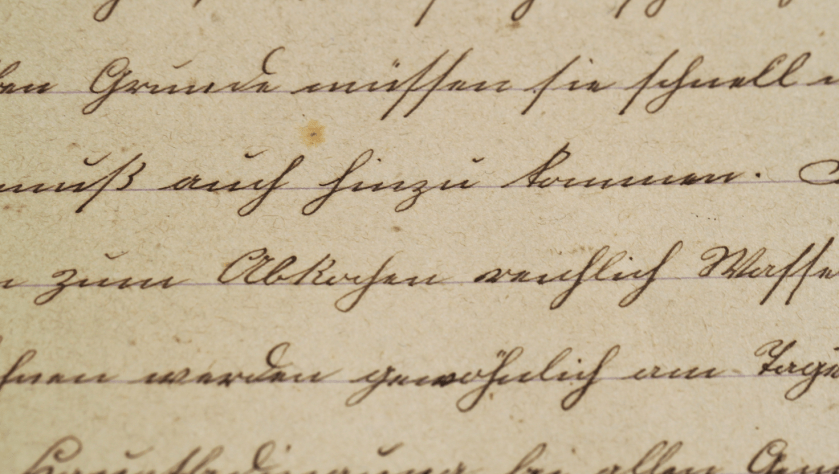

Treasures of the past often lie in handwritten records—birth registers, ship manifests, family letters, and faded diary pages. While these sources are invaluable, they can also be among the most challenging to read, especially when confronted with old handwriting styles, archaic spelling, and damaged paper.
Now, artificial intelligence (AI) is stepping in as a game-changer. Through Handwritten Text Recognition (HTR), AI can “read” these historical documents, converting them into searchable, digital text that can be preserved, shared, and analyzed more easily than ever before.
Why AI Handwriting Recognition Matters for Genealogists
- Breaking the handwriting barrier – Whether the script is flowing Copperplate or cramped clerk’s scrawl, modern AI models can recognize letterforms with remarkable accuracy.
- Speeding up transcription projects – A ledger that once took weeks to transcribe by hand can now be processed in hours.
- Making records searchable – Once digitized, names, dates, and places in these documents can be indexed and searched instantly.
- Preserving fragile originals – AI enables researchers to work from high-resolution images rather than handling delicate paper.
Modern HTR tools use deep learning, training on thousands—sometimes millions—of handwritten samples. The AI learns to identify patterns in letter shapes, spacing, and even writing quirks. In genealogy, this process can be tailored to:
- Specific time periods (e.g., 18th-century secretary hand)
- Specific languages (including obsolete letterforms and diacritics)
- Mixed content documents, such as registers that contain printed headings and handwritten entries
Challenges and Limitations
- Accuracy varies – Unfamiliar scripts, poor scans, and ink bleed can reduce precision.
- Language and spelling changes – AI may misinterpret obsolete words or letters without targeted training data.
- Need for human review – Just like traditional transcription, genealogists should verify and correct AI output to ensure reliability.
The Future: AI + Genealogist Collaboration
The future of AI in genealogy isn’t about replacing the researcher—it’s about empowering them. AI can handle the laborious first pass, leaving the genealogist to focus on interpretation, context, and connecting dots between generations.
In the next few years, expect to see:
- Integrated AI transcription in major genealogy databases
- Collaborative correction platforms where users refine AI results for everyone’s benefit
- Context-aware models that recognize not just words, but also their genealogical significance (e.g., identifying godparents or witnesses in church records)
Final Thought:
For genealogists, handwritten records are both a challenge and a joy. With handwriting recognition, we can unlock stories faster, and preserve them for future generations.
National Archives and Records Administration (NARA), “Using Artificial Intelligence to Unlock Handwritten Records,” accessed September 14, 2025, https://www.archives.gov/research/ai
FamilySearch, “Artificial Intelligence and Handwriting Recognition in Genealogy,” FamilySearch Blog, March 2021, https://www.familysearch.org/en/blog/ai-handwriting-recognition
Transkribus, “Handwritten Text Recognition for Historical Documents,” READ-COOP, accessed September 14, 2025, https://readcoop.eu/transkribus
Library of Congress, “Machine Learning for Civil War Pension Files,” accessed September 14, 2025, https://labs.loc.gov
Brigham Young University, “AI and Historical Handwriting Projects,” BYU Family History Technology Lab, accessed September 14, 2025, https://fhtw.byu.edu
 South Central Chapter, Association of Professional Genealogists