


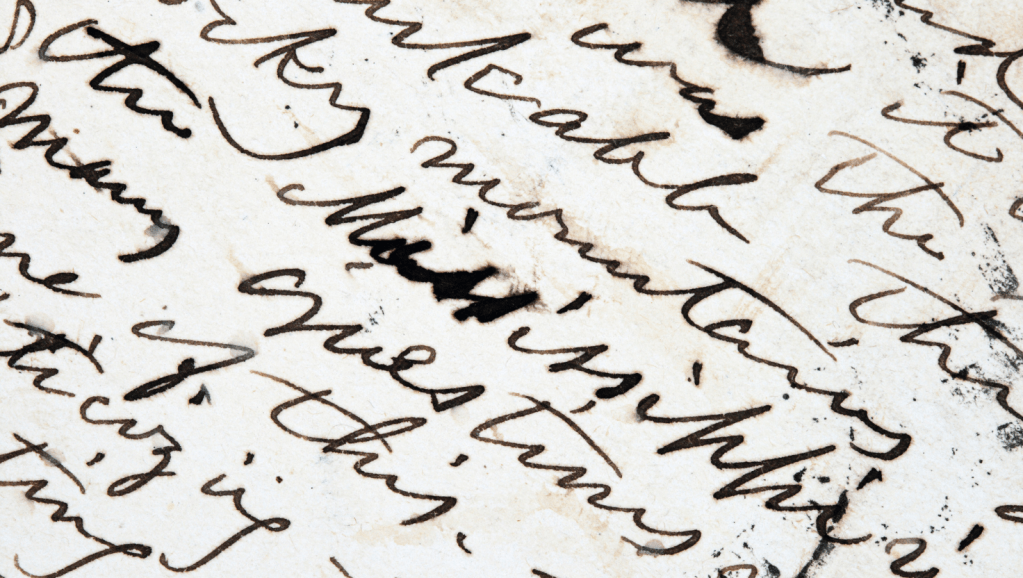
For many genealogists, handwritten records are a portal to the past. From parish registers to census rolls, handwritten sources are often the only surviving evidence of our ancestors’ lives. These records may have challenges: fading ink, archaic scripts, inconsistent spelling, and sometimes entire pages lost to time.
Today, artificial intelligence (AI) is helping to overcome these challenges, not only transcribing text but also interpreting and enhancing records.
Beyond Transcription: AI as a Historical Interpreter
Unlike traditional optical character recognition (OCR), which was built mainly for clean printed text, AI handwriting recognition learns the style and context of writing. Some emerging systems can:
- Differentiate between clerks who wrote in the same record book by analyzing pen pressure and slant.
- Detect names and relationships by context, not just by spelling, helping to catch variations like “Jonson,” “Johnsson,” and “Jensen.”
- Flag anomalies that a genealogist might miss.
This makes AI not just a tool for reading words, but a partner in understanding historical context.
Preserving More Than Words
AI is also being used to digitally repair damaged records before transcription. Advanced imaging techniques, powered by machine learning, can:
- Enhance faded ink on parchment or paper.
- Separate overlapping entries on crowded census pages.
- Reconstruct torn or missing text through pattern prediction.
For genealogists, this means recovering names and details that might otherwise remain invisible.
Real-World Genealogical Projects
- National Archives Initiatives: Some national and regional archives are training AI models on centuries of church registers, allowing bulk transcription of baptism, marriage, and burial entries for searchable databases.
- Civil War Pension Files: AI handwriting projects have been applied to military records, identifying names of soldiers, widows, and dependents, which enrich genealogical databases for descendants.
- Local Genealogy Societies: Community-driven projects use AI transcription as a starting point, then invite volunteers to verify and correct results—combining machine speed with human accuracy.
Expanding Access Through Collaboration
What’s exciting is how AI is making handwritten records more democratic. Before, only archives with large budgets could afford digitization and transcription. Now, with cloud-based tools and open-source platforms, local genealogical societies and individuals can use AI to process their collections.
Challenges That Remain
- Accuracy Gaps: AI still struggles with unusual handwriting or records written in multiple languages on the same page.
- Cultural Nuances: Some AI models misinterpret diacritical marks or older alphabets (e.g., Gothic script in German, or secretary hand in English).
- Verification Needs: Every AI transcription should still be checked by a researcher to ensure reliability.
Handwritten records remain the heart of genealogy. While past generations of researchers relied solely on patient eyes and magnifying glasses, today’s genealogists have AI as a powerful ally. With its ability to enhance, interpret, and connect these records, AI ensures that the fragile words of our ancestors continue to tell their stories for centuries to come.
National Archives and Records Administration (NARA), “Using Artificial Intelligence to Unlock Handwritten Records,” accessed September 14, 2025, https://www.archives.gov/research/ai
FamilySearch, “Artificial Intelligence and Handwriting Recognition in Genealogy,” FamilySearch Blog, March 2021, https://www.familysearch.org/en/blog/ai-handwriting-recognition
Transkribus, “Handwritten Text Recognition for Historical Documents,” READ-COOP, accessed September 14, 2025, https://readcoop.eu/transkribus
Library of Congress, “Machine Learning for Civil War Pension Files,” accessed September 14, 2025, https://labs.loc.gov
Brigham Young University, “AI and Historical Handwriting Projects,” BYU Family History Technology Lab, accessed September 14, 2025, https://fhtw.byu.edu
 South Central Chapter, Association of Professional Genealogists