


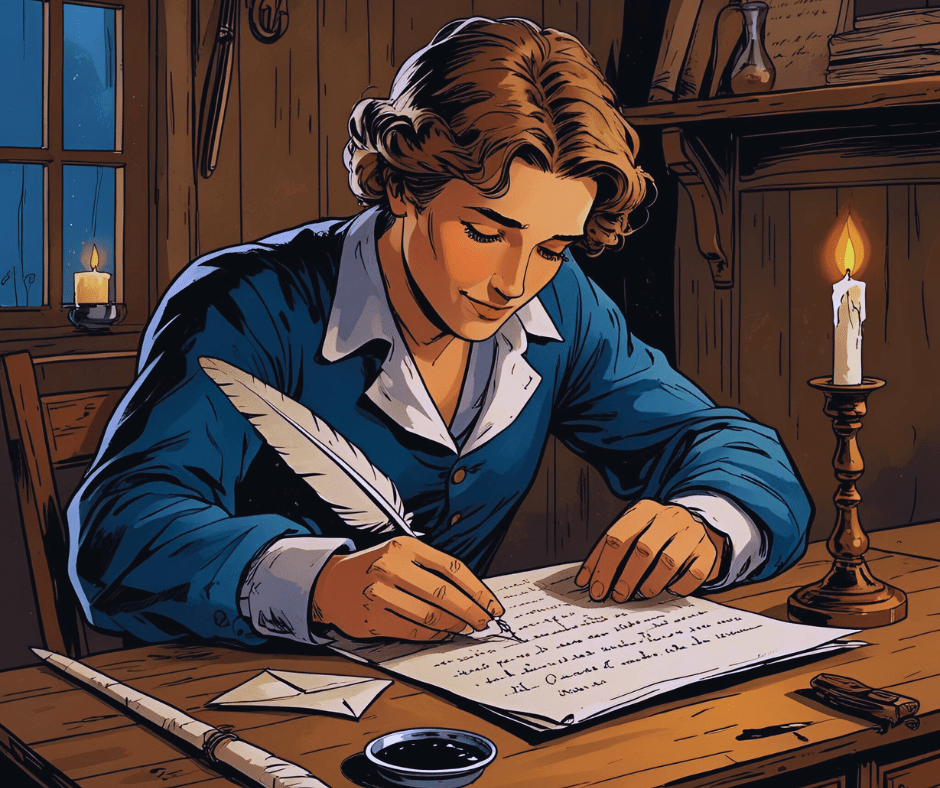
By the 18th century, handwriting began to take on a style that is more recognizable to modern readers. Compared to the angular secretary hand of the 1600s, 18th-century scripts often appear smooth and more elegant. For genealogists, this means records from this period can be easier to read—though they are not without their quirks.
The Dominant Styles: Round Hand and Copperplate
In the 1700s, handwriting shifted toward Round Hand, also known as Copperplate, which became the standard script taught across Europe and the American colonies. It was widely used in parish registers, legal documents, personal letters, and even advertisements.
Key characteristics:
- Flowing, rounded shapes—letters are more curved and consistent than earlier hands.
- Heavy emphasis on loops—in both ascenders (letters like “h” and “l”) and descenders (letters like “g” and “y”).
- Fine upstrokes, thick downstrokes—a product of the pointed quill pen.
- Ornamental capitals—particularly elaborate in formal documents.
Tricky Letters and Common Confusions
Even with its relative readability, 18th-century handwriting presents challenges:
- Long “s” (ſ) – Still common in the early 1700s, it resembles an “f” without the full crossbar. By the late century, its use declined.
- “r” – Often formed with a flourish that makes it resemble “v.”
- “p” and “q” – Their long tails sometimes stretch into neighboring words.
- “e” – May appear as a small loop, occasionally resembling “o.”
- Abbreviations – Clerks still used “ye” for “the,” “yt” for “that,” and “wch” for “which.”
Record Types Genealogists Encounter
- Parish registers – Births, marriages, and deaths were now more consistently recorded, though still subject to clerks’ individual handwriting styles.
- Colonial American documents – Wills, deeds, and tax lists from the 18th century often survive and are written in Round Hand.
- Military records – Wars of the century (e.g., the American Revolution) generated muster rolls, pension files, and correspondence, all in this style.
- Personal letters and diaries – Increasing literacy meant more ordinary people left written records.
Tips for Deciphering 18th-Century Handwriting
- Familiarize yourself with Copperplate alphabets—many penmanship manuals survive from the 1700s and show exactly how letters were taught.
- Pay attention to ink flow—quill pens leave thicker downstrokes and faint upstrokes; these help distinguish letters.
- Watch for flourished capitals—sometimes decorative swirls obscure the actual letter.
- Look for consistency—clerks often wrote the same letter form identically across a page.
- Mind the spelling—though more standardized than in the 1600s, spelling was still fluid.
The Genealogical Payoff
Eighteenth-century handwriting marks a sweet spot for genealogists:
- Easier to read than 17th-century secretary hands.
- More records survive thanks to growing literacy and record-keeping practices.
- Formalized scripts mean fewer surprises once you learn the quirks of Copperplate.
These documents open doors to key family history events—colonial life, revolutionary struggles, migration, and expanding church and civic records.
The 18th century was an age of elegance in handwriting. While the flourishes and long “s” can cause momentary confusion, the flowing Copperplate script makes this century’s records some of the most rewarding to read. With a bit of practice, genealogists can find that deciphering 18th-century handwriting is not only practical but also a window into the artistry of the written word.
George Bickham, The Universal Penman: A Collection of Examples of the Finest Writing Styles of the 18th Century (London: 1733–1741; reprint, Mineola, NY: Dover Publications, 2011).
George Shelley, The Second Part of Natural Writing (London: 1714).
Vivien Sklar, Reading Old Handwriting, 1500–1800: A Practical Guide (Kew: Public Record Office, 1999).
Tamara Plakins Thornton, Handwriting in America: A Cultural History (New Haven: Yale University Press, 1996).
FamilySearch Wiki, “England Handwriting,” last modified 2023, https://www.familysearch.org/en/wiki/England_Handwriting.
 South Central Chapter, Association of Professional Genealogists