


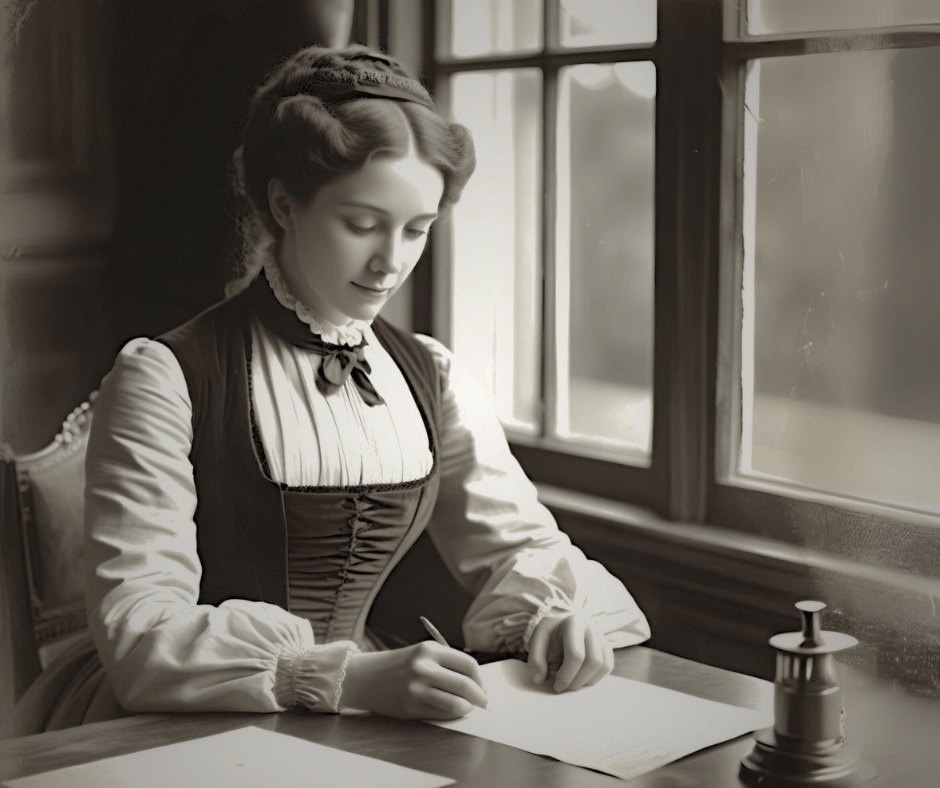
By the 19th century, handwriting underwent another shift. The 1800s introduced styles that were more practical, uniform, and widely taught. For genealogists, this means documents from the 19th century are often more legible—but still come with unique challenges.
The Dominant Styles: Spencerian and Palmer Hand
During the 19th century, penmanship evolved alongside education reform and industrial progress.
- Spencerian Script (mid-1800s):
- Developed in the United States by Platt Rogers Spencer.
- Known for its elegant curves, delicate loops, and rhythmic flow.
- Common in business records, personal correspondence, and ledgers.
- Designed to be both beautiful and practical.
- Palmer Method (late 1800s):
- Emerged toward the end of the century as a simplified, more practical script.
- Reduced flourishes and emphasized speed and uniformity.
- Adopted in schools, it became the standard script for everyday handwriting well into the 20th century.
Tricky Letters and Quirks of the 19th Century
Even with its relative legibility, 19th-century handwriting can cause confusion:
- Capital letters – Often ornate, especially in Spencerian, with flourishes that obscure the actual shape.
- “s” – The long s (ſ) had almost disappeared, but older clerks occasionally used it in the early 1800s.
- “r” and “n” – Looped “r”s and “n”s may look similar, requiring context to distinguish.
- Spacing issues – In hurried Palmer writing, words often run together, making “the man” look like “them an.”
- Abbreviations – Clerks still used shorthand such as “inst.” (this month), “ult.” (last month), and “do.” (ditto).
Common 19th-Century Record Types
- Census Records – Beginning in 1790 in the U.S., but by the 19th century, enumerators were using Spencerian or Palmer handwriting styles.
- Vital Records – Civil registration of births, marriages, and deaths expanded in the 1800s, producing standardized entries.
- Military Records – Civil War pensions, muster rolls, and draft registrations were handwritten in elegant script.
- Personal Documents – Diaries, family Bibles, and letters abound from this century due to increased literacy.
Tips for Deciphering 19th-Century Handwriting
- Learn the Spencerian alphabet – Many penmanship manuals survive and are available online for practice.
- Beware of flourish-heavy capitals – Identify them by comparing across the same page.
- Look for context in short words – Words like “in,” “on,” “an,” and “at” are easy to confuse.
- Check for clerk consistency – Census takers and record keepers usually repeated the same letterforms.
- Account for fading ink – Iron gall ink, common in the 19th century, can fade to brown and bleed through pages.
Why It Matters for Genealogists
The 19th century is a goldmine for family historians. Expanding literacy, improved record-keeping, and population growth mean more documents survive than ever before. Learning to read 19th-century handwriting helps genealogists unlock:
- Detailed census schedules with occupations, birthplace, and family structures.
- Military pensions with firsthand narratives and affidavits.
- Family Bibles that recorded generations in a single volume.
- Local government registers documenting property, taxes, and voting.
Nineteenth-century handwriting reflects both artistry and practicality. Spencerian script shows the beauty of penmanship at its peak, while the Palmer Method marks the beginning of efficiency in everyday writing. For genealogists, mastering these scripts transforms seemingly indecipherable lines into stories.
Platt Rogers Spencer, Spencerian Penmanship: Theory Book, New York: Ivison, Phinney, Blakeman & Co., 1866.
Austin Norman Palmer, The Palmer Method of Business Writing, Cedar Rapids, Iowa: A.N. Palmer Co., 1894.
Tamara Plakins Thornton, Handwriting in America: A Cultural History, New Haven: Yale University Press, 1996.
FamilySearch, “Reading 19th-Century Handwriting,” FamilySearch Wiki, last modified 2022, https://www.familysearch.org/en/wiki/United_States_Handwriting.
 South Central Chapter, Association of Professional Genealogists