

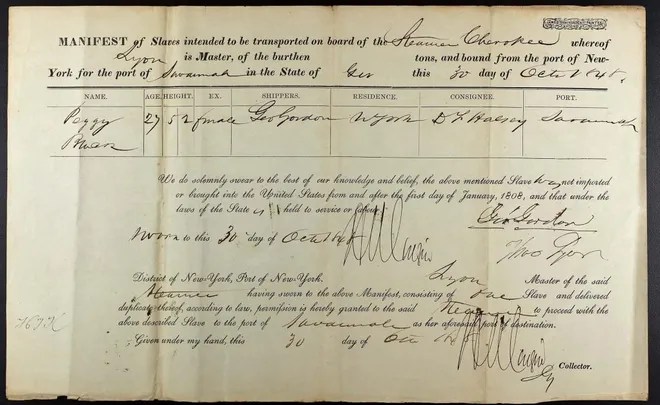
Ship manifests are invaluable tools for genealogists, but they are also sobering records of one of humanity’s darkest chapters—the transatlantic slave trade. From the 16th through the 19th centuries, millions of enslaved Africans were transported across the Atlantic. For family historians and descendants of enslaved people, ship manifests provide both evidence of existence and haunting testimony of erasure.
The Role of Ship Manifests in the Slave Trade
Unlike manifests that recorded free settlers by name, enslaved Africans were often listed as cargo. These manifests were designed to satisfy customs officials, merchants, and governments. Their purposes included:
- Tracking the number of enslaved persons on board.
- Assessing taxes and duties on human “cargo.”
- Documenting ownership and financial value.
- Providing proof of compliance with trade regulations.
In many cases, the enslaved were counted, not named, making it challenging for descendants to trace individual ancestors.
What Information Appears in Slave Ship Manifests?
Depending on the time period and port, manifests might include:
- Number of enslaved people (sometimes grouped by gender and age).
- Basic descriptors such as “man,” “woman,” “boy,” or “girl.”
- Origin (region in Africa or last port of embarkation).
- Condition or health (occasionally noted, especially during inspections).
- Survival numbers (to account for deaths during the Middle Passage).
- Owner or consignee’s name.
In later U.S. records (early 19th century), domestic slave trade manifests sometimes included first names and approximate ages, especially after laws required documentation of coastwise slave transport.
The Tragedy of the Middle Passage in the Records
The manifests bear witness to the horrors of the Middle Passage:
- High mortality rates were often noted, with dozens or even hundreds dying en route.
- Dehumanizing language reduced people to statistics—“125 negroes” instead of names.
- Cargo-like classification equated enslaved individuals with sugar, rum, or tobacco also listed on board.
These documents, while deeply painful, serve as reminders of the resilience of those who survived and the lives that were lost.
Using Slave Manifests in Genealogical Research
For descendants of enslaved people, these manifests can be both heartbreaking and essential. Here are strategies for working with them:
- Search databases and archives – Projects like the Trans-Atlantic Slave Trade Database and collections from the National Archives hold digitized manifests.
- Look at domestic trade records – After the U.S. banned the importation of slaves in 1808, manifests documenting coastwise trade became required and sometimes list names.
- Pair with plantation and probate records – Ship manifests often connect to bills of sale, wills, or estate inventories.
- Follow the ships – Researching voyages of specific ships can link to broader narratives of routes, ports, and trade networks.
- Use context – Even if individuals aren’t named, understanding the demographics of a voyage provides insight into ancestors’ likely origins and experiences.
Why These Records Matter
While ship manifests are stark reminders of injustice, they are also tools of recovery. Each entry, whether a name or a number, represents a life that endured unimaginable hardship. For genealogists, they help restore fragments of family history erased by slavery.
They remind us that family history research is not just about celebrating the past—it’s about acknowledging its wounds, honoring resilience, and preserving truth for future generations.
Ship manifests that recorded enslaved Africans are more than bureaucratic paperwork—they are evidence of survival. For genealogists, engaging with these records is both an act of research and an act of remembrance.
Links
https://www.savannahnow.com/story/news/2011/02/04/slave-manifests-tell-story/13439898007/
 South Central Chapter, Association of Professional Genealogists