

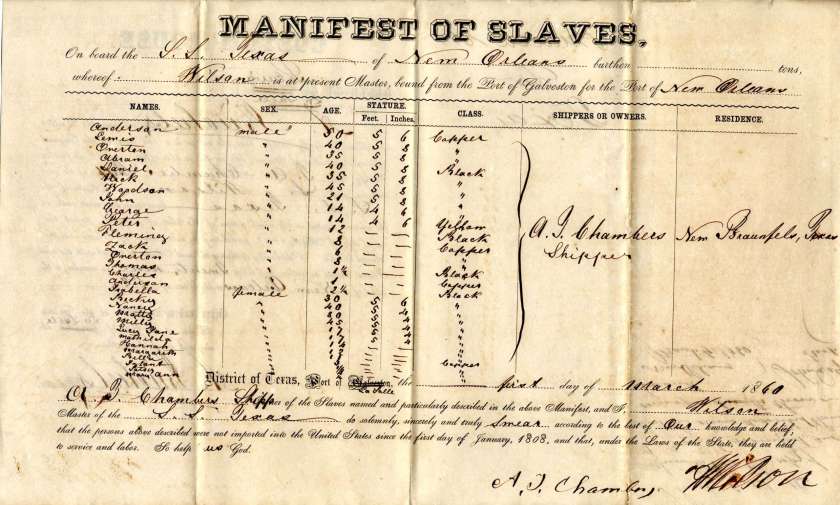
When we think of ship manifests, we often picture tidy lists of passengers and goods crossing the Atlantic. But for millions of Africans forcibly transported during the slave trade, these documents tell a very different story. Instead of recording them as individuals with families, histories, and futures, ship manifests reduced the enslaved to lines of cargo—mere numbers in a ledger. For genealogists, these records are both heartbreaking and essential, offering rare glimpses into a past where identity was stripped away.
Ship Manifests as Instruments of Control
In the 17th, 18th, and early 19th centuries, ship manifests were designed to serve governments, traders, and ship owners. They acted as proof of compliance with regulations, verified taxation on human cargo, and reassured investors of profits. In these documents, enslaved people were listed alongside barrels of sugar or crates of rum.
The focus was not on who these people were, but on how many were aboard, how many survived the voyage, and what their “market value” might be upon arrival.
What the Records Reveal
Though dehumanizing, slave ship manifests still provide fragments of information that can be invaluable to descendants and researchers:
- Numbers by category: Men, women, boys, and girls were often counted separately.
- Ports of origin: Sometimes the manifest lists embarkation points in West Africa, such as Angola, Senegambia, or the Gold Coast.
- Ship details: Name of the vessel, captain, and owner help researchers trace multiple voyages.
- Survival statistics: The difference between departure and arrival counts reflects the mortality of the Middle Passage.
In rare cases, especially in the early 19th century when laws tightened in the United States, enslaved persons’ first names and approximate ages were recorded in domestic trade manifests.
Research Pathways for Descendants
Working with slave manifests requires patience, creativity, and compassion. Researchers can:
- Consult databases – The Trans-Atlantic Slave Trade Database is a vital starting point for identifying specific ships, routes, and voyages.
- Explore archives – The U.S. National Archives, British National Archives, and Caribbean repositories contain surviving manifests.
- Pair records – Manifests often connect with bills of sale, advertisements for auctions, and probate records that may list enslaved individuals by name.
- Use community resources – Many African American genealogical societies and projects focus on reclaiming and indexing these records.
Why These Records Matter Today
Though written with cold detachment, ship manifests documenting enslaved Africans have become records of resilience. They confirm the presence of those who endured the Middle Passage and lay a foundation for descendants to reclaim lost history.
For genealogists, engaging with these manifests is not just about finding names or numbers—it is about restoring humanity to those stripped of it on paper.
Ship manifests that carried the enslaved are grim artifacts, but they are also powerful tools of memory.
“Slave Manifests of Coastwise Vessels Filed at New Orleans, Louisiana, 1807-1860.” U.S. National Archives. Accessed September 13, 2025. https://www.archives.gov/research/african-americans/slave-ship-manifests.html. National Archives
“Ship Manifests and the Interstate Slave Trade.” New Jersey Slavery Records project. Accessed September 13, 2025. https://records.njslavery.org/s/doc/page/ship-manifests. records.njslavery.org
“Civilian Records Relating to Slavery: Slave Manifests.” U.S. National Archives. Accessed September 13, 2025. https://www.archives.gov/research/african-americans/slavery-records-civil.html. National Archives
“Transoceanic Mortality: The Slave Trade in Comparative Perspective,” HS Klein et al. William & Mary Quarterly 58, no. 1 (2001): 125-58. Accessed September 13, 2025. https://web.stanford.edu/~hklein/Klein_etal_Mortality_ST_WMQ-2001.pdf. Stanford University
“Slave Voyages.” SlaveVoyages.org. Accessed September 13, 2025. https://www.slavevoyages.org.
 South Central Chapter, Association of Professional Genealogists